Bedwetting in
older children.
It is one of the most common reasons a family starts looking for a larger size, and one of the least talked about. Your child is old enough now that the shops assume they no longer need diapers. The shelves stop at sizes that were built for someone half their size, and what is left fits badly or not at all.
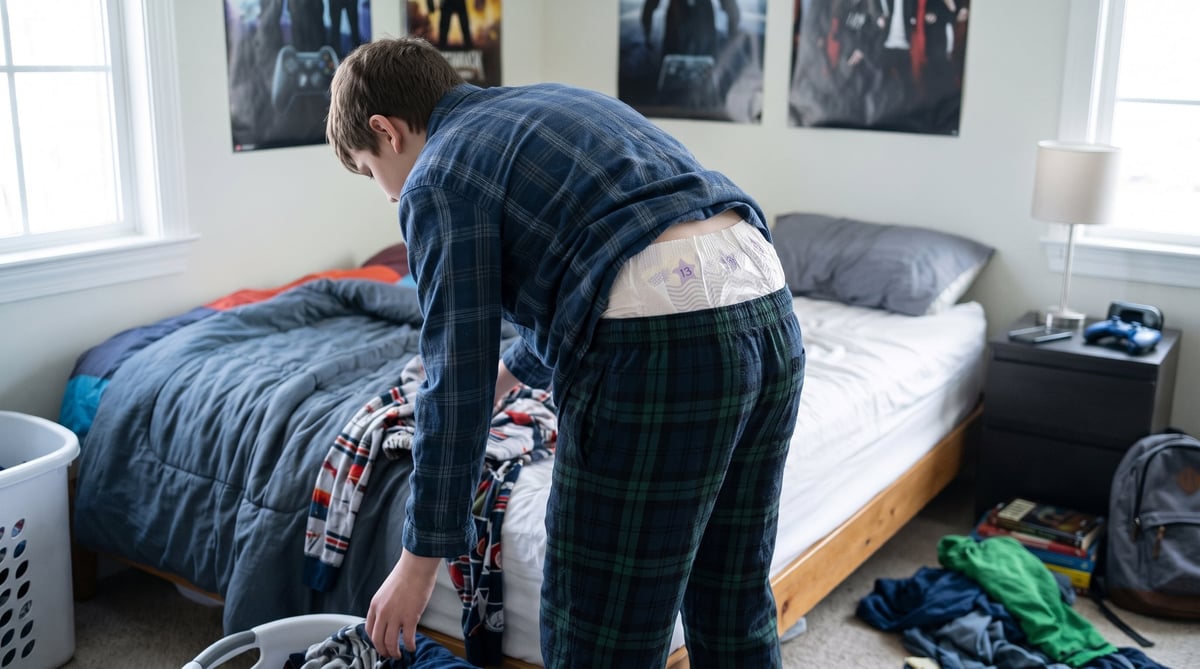
What the shelves get wrong
A child who wets the bed at ten does not need a product designed for a three year old. The absorbency is too low for a full night, the fit is too small across the waist, and a pull up style will leak at the legs by morning because it cannot be snugged up where it matters.
That is why so many families end up improvising: doubling products, layering towels, or waking a child in the middle of the night to use the bathroom. None of it solves the problem, and all of it adds stress to something that is already worrying.
What actually helps is a product sized to the child, with enough capacity for a night's worth, and enough adjustment to sit snug at the legs. That is what we are building: youth sizes with a larger core and a tab on each side.
The short version
- Sizes are chosen by weight, not age.
- A tab diaper fits snug at the legs where pull ups gap.
- Youth sizes run from 55 to 185 lbs.
- It is common at this age, and it usually passes.
Far more common than anyone says out loud.
Parents almost always assume their child is the only one. The numbers say otherwise. Roughly one child in every classroom at age ten wets the bed, and almost none of them mention it.
Age 5
About 1 in 5
Often treated as the upper limit of normal. Most are still dry more nights than not.
Age 7
About 1 in 10
The age where families start to notice it is not resolving, and the shops stop helping.
Age 10
About 1 in 20
Around one child in every classroom. Almost none of them talk about it.
Age 12
About 1 in 30
Still common enough that a pediatrician sees it weekly, and rarely needs to do anything.
Age 15
About 1 in 50
Around one in fifty teenagers. This is where an adult product usually gets offered, and why youth sizes exist.
Boys are about twice as likely as girls at every age. None of these figures mean something is wrong with your son: they mean he is standing in a very large group who mostly don't talk about it.
The pattern tells you more than the frequency.
Almost every case falls into one of four patterns, and they mean quite different things. The one that matters is usually not how often it happens, but whether it has been consistent.
Every night, and always has
The most common pattern, and the least likely to mean anything is wrong. The signal from the bladder to the brain that wakes a child has simply not developed yet. It usually arrives, often around a birthday, without any intervention at all.
Some nights, not others
Patchy wetting usually means capacity and sleep depth are both improving and sometimes losing the race. It tends to become less frequent over months rather than stopping on a date. Bad weeks after a late night, a big drink or an illness are normal.
Dry for months, then wet again
A true relapse after a long dry stretch is the one pattern worth mentioning to a doctor, especially if it comes with a change in daytime habits, thirst, or behavior. It is often nothing, but it is the one that gets checked.
Only on trips, sleepovers or vacations
Very common, and almost always down to broken routine, later nights and drinks at odd times. It is also the pattern where families most often wish they had packed a product rather than relying on an unfamiliar spare.
Three things, and the third is the product.
A product that actually holds the night
Not a baby product with a bigger print. A larger core and a tab on each side, so it is snug at the legs for eight hours rather than gaping by two in the morning. This is the single change that most families report as the turning point.
A fit set before he is asleep
Fasten it snug while he is lying down, after the last bathroom visit. A product that was comfortable standing can shift once a child is asleep for hours, and the gaps at the legs are where the leak starts.
Why it is more common in boys
Boys are roughly twice as likely to wet the bed as girls at every age, and the reason is not fully understood. Hormone timing and bladder capacity are both implicated. It means a boy who wets is in a very large group, not an unusual one.
The things you end up googling at midnight.
01Is bedwetting at this age normal?
It is more common than most parents realize. Many children still wet the bed at seven, eight and well beyond, and for most it fades on its own over time. It is not usually about effort, discipline or laziness. The important thing is that your child is not made to feel ashamed of something they are not choosing.
02What size do I need?
Sizes are set by weight, not age. A child between 82 and 100 lbs, for example, would start in Size 11. Youth sizes run from 55 to 185 lbs across six weights, which is the range most children outgrow before the shops' largest sizes stop. If your child sits between two sizes, start with the larger one and adjust the tabs.
03How long can one hold through the night?
That depends on the child, how much they drink in the evening and the fit. A comfortably full, well fitted diaper covers an ordinary night for most children. If mornings are regularly wet through, look at size first, then at when drinks stop in the evening.
04Should we wake them to change in the night?
Usually not. An undisturbed night matters more than a dry product, and waking a child to change them tends to make the whole routine feel bigger than it is. Change if the diaper is full enough that they are uncomfortable or at risk of soreness. Otherwise deal with it in the morning.
05What about sleepovers and camp?
Most families handle it discreetly rather than avoiding it. Pack a couple of products and a disposal bag in an ordinary wash bag, so getting ready for bed is your child's own business. Let them decide whether to mention it to a friend. The fewer adults making a thing of it, the easier it is for them.
06When should we talk to a doctor?
Worth a conversation if bedwetting starts suddenly after a long dry stretch, if there are daytime symptoms too, if it is painful, or if your child is distressed by it. Most bedwetting is developmental and nothing to worry about, but a check costs little and rules out the things worth ruling out.
07Should we limit drinks before bed?
Move big drinks earlier rather than cutting them off. A drink with dinner is fine; a large one an hour before bed usually works against you. Cutting fluids across the evening can leave a child thirsty and fretful and rarely solves the night.
08Will a diaper stop them learning to stay dry?
There is no evidence that a comfortable, well fitted product delays anything. Children develop night dryness on their own timeline, and a child who is sleeping properly in a diaper is in a better place to develop it than one who is wet, cold and waking three times a night.
09Is it worth trying a bedwetting alarm?
They exist and some families use them, but they suit a specific child and a specific household, and they take weeks of disrupted nights to work, if they work. What we would say is this: the diaper solves the night now, without anyone losing sleep, and nothing about using one prevents a parent from trying a training approach later. Most families settle the nights first.
10Does it affect school or daytime behavior if untreated?
Sleep is what carries over. A child being woken several times a week, or sleeping in a wet bed, is a tired child, and tired children of this age tend to show it in patience and behavior before anything else. That is one of the strongest practical arguments for covering the night now rather than waiting.
11What if he wants to stop wearing one?
That is worth listening to, and it usually means the changes are working. If he has had a long dry stretch, try a week without and keep a few products in the closet. Going back is not a failure, and it is much easier to go back if it was never built up as a big ending.
12How do we make it feel normal?
Treat it as part of getting ready for bed, like brushing teeth. Have the product within reach so your child can put it on alone where they are old enough, keep spare bedding close by, and avoid talk of accidents or blame. A quiet routine at night and a calm morning matter more than anything.
What a settled evening looks like
The families who find this easiest tend to have a routine that does not change much. Same order, most nights, without anyone making a fuss.
- 1
Drink with dinner, not after.
Most of the evening's fluid earlier in the evening.
- 2
Last bathroom visit before bed.
Teeth, then the bathroom, then the product on.
- 3
Product on, then lights out.
Handled like brushing teeth, part of the routine.
- 4
Spare bedding within reach.
A waterproof cover and a spare set in the room.
- 5
Morning is quiet.
No comment if it held, no comment if it did not.
The tone matters most
Children remember how a wet morning felt, long after they forget the product. What they need from you is that it was not a problem. A quiet change, a normal breakfast, and no conversation about it unless they start one.
- No blame, and no “again?”
- No reward for a dry night
- No discussion of it in front of others
- No hint that it is costing you something
Four things that make a real difference.
A parent fits it, and that is fine
Most families assume a child around eight should be doing this himself, and most find he can't, or can't get it snug enough to hold. A parent or caregiver applying it is the normal thing to do at this age, and it is the difference between a product that works and one that leaks. From thirteen or fourteen a boy may be able to fasten it properly himself, and even then many still prefer a parent to do it. It depends on the child, not on a date.
Make a wet night easy to fix
A waterproof mattress cover, a spare set of bedding kept in the room, and a nightlight near the spare clothes turn a wet night into a five minute tidy up instead of a household event.
Keep the routine calm
A drink with dinner is fine. A large drink an hour before bed usually is not. A last bathroom visit before sleep, then the product on, then lights out. Same order, most nights.
Say nothing in the morning
If it held, no fuss. If it didn't, no comment. Children notice more than parents expect, and the tone you set at breakfast is what decides whether they feel supported or embarrassed.
Want the full walkthrough?
The guide takes your reason and walks through sizing, the first night, the routine and what to do when something isn't working.
The question that comes right after
What about needing to go in the night?
At night he stays in the diaper, which is exactly what it is for. If he wakes and tells you he has gone, change him quietly where he is and let him go back to sleep. If he wakes and needs to go, the answer is the same, and it is a one minute thing, not a trip down the hallway.